
 By
By 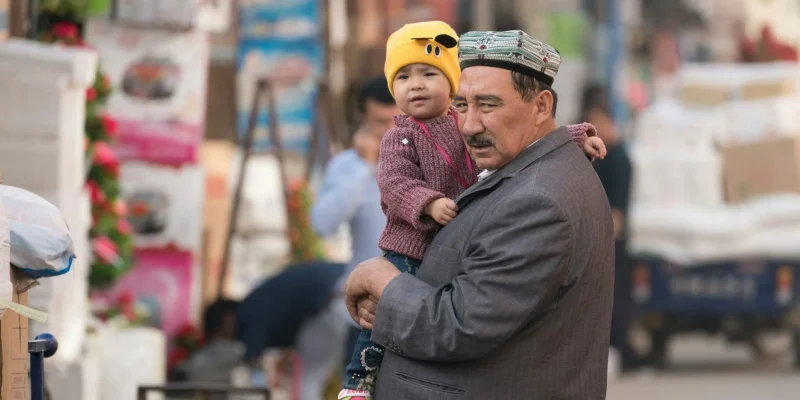
August 8th, 2025
Alexa Sporner
Asia Team Human Rights Researcher,
Global Human Rights Defence.
China continues the operation of the orphanage-style boarding schools in the Xinjiang region. According to Radio Free Asia, these facilities receive Uyghur children whose parents are detained by the Chinese authorities (Hoshur for Radio Free Asia, 2025) and thus further deepen the Chinese Communist Party’s (CCP) aim to reduce the large ethnic differences, and to form the region to the Han Chinese culture (Ceric, 2025).
The Uyghurs have been a focus in China’s internal politics for the past few decades, mainly because of the cultural and religious differences. The majority of the Uyghur population are Muslim and share cultural and lingual similarities with other Turkic ethnicities, including some of the neighbouring countries in the region. Strategically, Xinjiang itself is a very important region for China, specifically for national security, as it shares a border with 8 countries, and for economic reasons due to its richness in gas and oil. Therefore it is evident the CCP wants to have a hold of it (Duguri, Salleh and Hassan, 2021).
In the past decade the CCP have built hundreds of the so-called “re-education centers” or “training centers” which according to Chinese authorities serve to prevent terrorism and religious extremism (BBC, 2022). However, many reports suggest that these facilities are the home of thousands of detained Uyghurs, where they suffer from torture and forced cultural assimilation (International Bar Association, 2025).
However, these implementations also affect the children of the region. Since the “Strike Hard” campaign in 2014, China has been opening more and more boarding schools for Uyghur children in the Xinjiang Region, specifically whose parents are absent (in many cases they are being detained by the authorities), thus forcibly removing them from their families and homes. These boarding school facilities are designed to transform the identity of the Uyghur children and to practice Han Chinese culture. In the recent report of The Centre of Uyghur Studies (CUS) they draw the attention to not only the political and legal issues and consequences, but the long term trauma and psychological damages these boarding school facilities can cause to the children. They emphasise that forcing children to give up on their cultural identity and to stop speaking their mother tongue results in losing the memory of their personal history and even losing the memory of their families. The report of the Centre of Uyghur Studies clearly states that the aim of the Chinese authorities is to form the next generation of Uyghur’s to represent the Han Chinese culture (Centre for Uyghur Studies, 2025).
In the past years, the situation has drawn the attention of many countries, advocates and NGOs, many of whom have referred to the situation as a cultural genocide, referencing Article II of the Convention on the Prevention and Punishment of the Crime of Genocide, which includes “forcibly transfering children of the group to another group”.
To address these human rights concerns, the International Bar Association’s Human Rights Institution has organised a panel for discussion at the beginning of the year, where Uyghur and Turkic representatives raised their concerns and advocated for the region’s protection and autonomy (International Bar Association, 2025).
Although in March 2024, there have been news that the Chinese government closed the “re-education camps” (Sander and Kamp, 2024), the same cannot be said about the boarding schools for the Uyghur children. The enrolment of children in such institutions is still an ongoing issue, particularly raising concerns about minority rights and the long-term effects of a government controlled education in the region.
Sources and further readings:
BBC World News (2022, May 24). Who are the Uyghurs and why is China being accused of genocide? <https://www.bbc.com/news/world-asia-china-22278037>
Center of Uyghur Studies (2025, May 13). New Report: China’s Use of Boarding Schools as a Tool of Genocide Against Uyghur Muslims. <https://uyghurstudy.org/new-report-chinas-use-of-boarding-schools-as-a-tool-of-genocide-against-uyghur-muslims/>
Ceric, R. (2025, April 13). Chronology of Evil: The Genocide of the Uyghurs. Tacno.Net (accessed on 2025, August 7) <https://tacno.net/chronology-of-evil-the-genocide-of-the-uyghurs/>
Duguri, U. S., Salleh, M. A. & Hassan, I. (2021, December 1) The Xinjiang Uyghur Autonomous Region’s Historical Background and Uyghur Human Rights Situation. Isagoge: Journal of Humanities and Social Sciences 1(6) page 102-116 <https://www.telosjournals.com.br/ojs/index.php/isa/article/view/66/51>
Hoshur, S. (2025, January 16). China expands orphanage-style boarding schools for Uyghur children. Radio Free Asia (accessed on 2025, August 7) <https://www.rfa.org/english/uyghur/2025/01/16/children-boarding-schools/>
International Bar Association (2025, January 23). A cohort of organizations spotlight the ‘forgotten genocide’ of Uyghurs by China. <https://www.ibanet.org/A-cohort-of-organisations-spotlight-the-forgotten-genocide-of-Uyghurs-by-China>
Sander, M. & Kamp, M. (2024, March 7). Has China really closed its re-education camps in Xinjiang? NZZ – International View <https://www.nzz.ch/english/secret-security-area-no-photography-allowed-china-has-officially-closed-the-camps-in-xinjiang-and-now-ld.1820729>



Comments