
 By
By 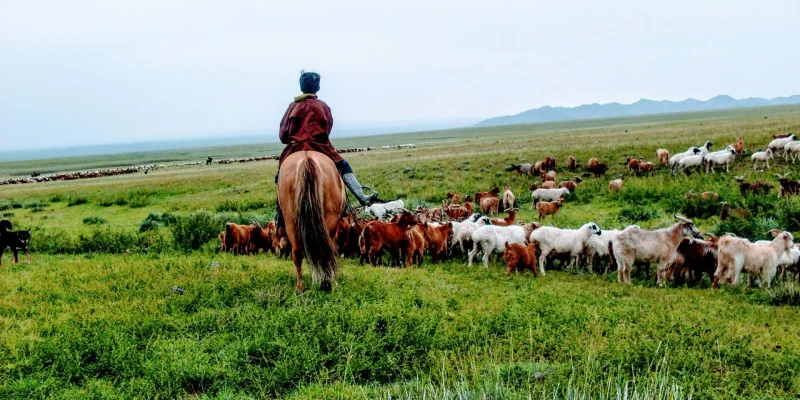
August 22nd, 2025
Alexa Sporner
Asia Team Human Rights Researcher,
Global Human Rights Defence.
The mining booms in Mongolia are a very important practice in spite of the country’s economy, however the activity negatively impacts the climate change, natural resources and therefore it endangers the lifestyle of the Mongolian nomadic herders.
The mining industry in Mongolia is responsible largely for the country’s exports, as well as it employs more than 70 thousand people. However, the mining practices result in land degradation of land and significantly damaging natural resources in the affected areas (East Asia Forum, 2025).
One of the biggest concerns regarding the operation of the mining sector is the negative effects the activity has on water. Mongolia’s water resources are already limited, however the mining industry uses tens of millions of m³ water per year. In a recent study of the Institute of Geography and Geoecology Mongolian Academy of Sciences, it is shown that the continuing development of the mining enterprises and the increasing water consumption for mining purposes can affect the everyday life of the local nomadic herders and the local wildlife, as the mining activity can result in the dropping of groundwater levels as well as the drying out of the local ecosystem (Enkh-Amgalan, Sarantsetseg, Emelianova, Dugarova, Gagarinova, Belozertseva & Tszian, 2025).
Mongolian nomadic herders are continuously being displaced by the government to use their land for opening more and more mines. The national laws are prioritising the economic growth of Mongolia, and therefore the government allows mining companies to conduct business in rural areas. Local herders thus do not have access to their ancestral homelands, resulting in seasonal migration and the increase of conflicts between different nomadic communities. Additionally, the country’s economic goals undermine its goals for sustainability, and therefore it contributes to the increasing climate challenges that also play an inevitably important role in the challenges Mongolian nomadic herders face (Dovchin, U. & Dovchin S., 2024). This is, however, an issue of human rights violations with regards to the right to water, the right to land and the state’s responsibility to protect under the United Nations’ Resolution adopted in 2018 (United Nations).
In the past couple of decades, the Mongolian government has tried to find a solution, however most of these practices are not effective in the long term. In terms of the Oyu Tongi Investment Agreement the government restricted its regulations towards the South Gobi mining companies, however this did not include local herder representatives (East Asia Forum, 2025).
Mongolian nomadic herders are significantly contributing to the agriculture in Mongolia. If they cannot continue their practices, it will be a great loss for Mongolia’s economy, and it will transform a several century old community (Food and Agriculture Organization of the United Nations, 2021).
Sources and further readings:
Chuluunbat, N. (2025, February 7) The hidden cost of Mongolia’s mining boom. East Asia Forum, accessed on the 19th August 2025 <https://eastasiaforum.org/2025/02/07/the-hidden-cost-of-mongolias-mining-boom/>
Enkh-Amgalan, S., Sarantsetseg, B., Emelianova, N., Dugarova, G., Gagaroniva, O., Belozertseva, I. & Tszian, K. (2025, May 22) Ecological Problems in the Mining Areas of Gobi. 2025 International Conference on Eco-environmental Protection, Environmental Monitoring and Remediation (EPEMR 2025) Volume 630 (2025), accessed on the 19th August 2025 <https://www.e3s-conferences.org/articles/e3sconf/abs/2025/30/e3sconf_epemr2025_02016/e3sconf_epemr2025_02016.html>
Dovchin U. & Dovchin S. (2024, August) The discourse of the Anthropocene and posthumanism: Mining-induced loss of traditional land and the Mongolian nomadic herders. Ethnicities, 24(4), accessed on the 19th August 2025 <https://journals.sagepub.com/doi/epub/10.1177/14687968231219777>
Food and Agriculture Organization of the United Nations (2021) Pastoralism in Mongolia, a needed balance between production and sustainable use of natural resources, accessed on the 19th August 2025 <https://openknowledge.fao.org/server/api/core/bitstreams/66984f04-a8fb-46ee-8155-0944f82b2b38/content>
United Nations General Assembly (2018, September 28) United Nations Declaration on the Rights of Peasants and Other People Working in Rural Areas. Resolution adopted by the Human Rights Council on 28 September 2018.



Comments