
 By
By 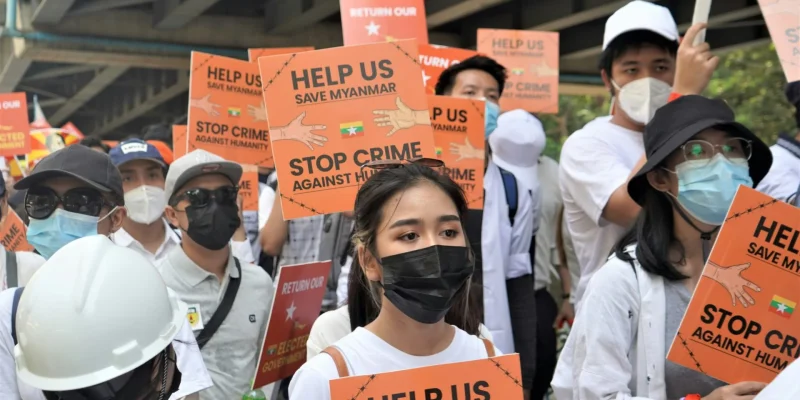
22-04-2026 | Dominik Miklósi | Asia Researcher,
Global Human Rights Defence.
The military regime of Myanmar argues that specific menstrual products, such as sanitary towels, are being employed by the members of the People’s Defence Force for first aid reasons. Thus, the leadership of the country implemented a ban on their distribution, resulting in heavy condemnation by medical experts, human rights activists, and others.
During the bloody civil war, the military junta of Myanmar, which has been running the country since the coup d’état carried out against the democratically elected government in 2021, continues to widen its ban on period products. Specifically, the recently implemented prohibition concerns sanitary towels, as according to the junta, these are being used by rebels for first aid purposes. “The [military is] saying menstrual products are used by the People’s Defence Force for medical reasons and as support for their feet and boots to absorb sweat and blood”, said Thinzar Shunlei Yi, a director of Sisters2Sisters, a women’s rights organisation. This move raises several human rights concerns, and activists refer to it as an apparent example of gender-based violence. The ban is realised through blockades established by the military with the aim of cutting off supplies, which has been a long-term practice with other products as well.
Nevertheless, the claim made by the military regime that the sanitary towels are applied for healing reasons has been heavily contested. For instance, Meredith Bunn, from Skills for Humanity, a humanitarian medical aid organisation, said the following on the matter: “A sanitary pad wouldn’t stay in place, wouldn’t soak enough blood and wouldn’t keep the area [clean]”. Based on Bunn’s words, such menstrual products could never be effective enough to medically treat any serious wounds sustained from combat. Additionally, the medical expert described the personnel who made the decision concerning the restriction as “completely uneducated, misogynistic fools within the military”.
Lastly, it has been argued that the ban particularly targets the prevention of women’s participation in politics, along with the aim of hindering their mobility in the fight against the regime. The junta’s prohibition is a serious threat to, among others, the right to health, freedom from discrimination, and freedom from inhuman or degrading treatment. Hence, the international community must raise its voice and act against this step to promote and uphold women’s safety and health during this difficult period in the Southeast Asian country.

Comments